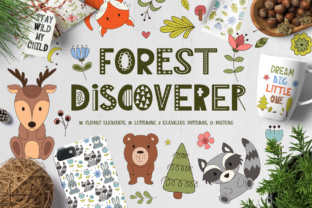
Forest Discoverer - Clip Art Posters
Forest Discoverer - Clip Art Posters isn’t just another digital asset pack—it’s a deliberately curated visual toolkit designed for people who make things that matter. Whether you’re launching an eco-conscious brand, designing classroom materials for early learners, crafting invitations for a woodland-themed baby shower, or building a cohesive social media campaign around nature education, this set delivers precision, consistency, and creative control. Its value lies not in volume alone—but in how thoughtfully its components interlock: hand-drawn animals, botanical elements, lettering phrases, seamless patterns, and ready-to-print posters all share the same aesthetic language and technical integrity.
Why Strategic Consistency Matters More Than Quantity
Many designers and small business owners collect clip art sets expecting “more assets = better results.” But Forest Discoverer - Clip Art Posters challenges that assumption. With 72 core clipart elements—32 in full color and 32 in clean outline, delivered in JPG, PNG, and EPS10—you gain flexibility without fragmentation. The EPS10 vector format ensures scalability for large-format prints like banners or wall decals, while the 300 ppi PNGs with transparent backgrounds support pixel-perfect web use on product labels, email headers, or digital course materials. That dual-format delivery isn’t convenience—it’s foresight. It means one decision about visual tone today supports multiple output channels tomorrow, reducing rework and preserving brand coherence across touchpoints.
When to Reach for Forest Discoverer - Clip Art Posters (and When Not To)
This set shines when your goal is intentional communication—not decoration for decoration’s sake. Use it when:
- You’re developing a nature-based curriculum and need consistent, age-appropriate visuals for worksheets, flashcards, and classroom posters;
- You’re launching a sustainable product line and require scalable, on-brand pattern overlays for packaging, fabric swatches, or website backgrounds;
- You’re building a content calendar around seasonal themes (e.g., “Spring Habitat Studies” or “Autumn Life Cycles”) and want reusable, modular assets that maintain visual continuity month after month;
- You’re creating physical products—like greeting cards, gift tags, or educational kits—and need print-ready files that retain fidelity at any size.
Avoid reaching for Forest Discoverer - Clip Art Posters if your project demands photorealism, abstract expressionism, or culturally specific iconography. Its strength is in its warm, approachable, hand-crafted realism—not hyper-detail or stylized minimalism. Using it outside its intended expressive range dilutes impact and risks visual dissonance.
How to Use the Lettering Set With Purpose
The 20 lettering phrases—available on black, white, and color backgrounds, plus EPS10 versions—all carry thematic weight: “Explore the Wild,” “Rooted in Wonder,” “Grow Wildly,” and “Little Foresters Unite.” These aren’t decorative filler. They’re micro-messages that reinforce positioning. For educators, pairing “Observe • Wonder • Protect” with a poster of a fox and ferns creates a learning anchor. For a small-batch soap maker, overlaying “Botanical & Kind” onto a seamless leaf pattern builds ethos before the customer reads a single ingredient list. The key is alignment: each phrase should reflect a real value you stand behind—not just sound pleasant.
Patterns as Infrastructure, Not Afterthoughts
The nine seamless patterns included in Forest Discoverer - Clip Art Posters function like visual infrastructure. Unlike standalone illustrations, patterns shape perception at scale: they define texture, imply quality, and establish rhythm. A subtle bark-texture pattern used across invoice templates, email footers, and packaging tape signals attention to detail—even if the customer never consciously registers it. Because these patterns are delivered in EPS, JPG, and PNG, they adapt seamlessly (pun intended) from digital UI backgrounds to textile mockups or wallpaper proofs. Think of them not as “extras,” but as foundational layers that unify disparate assets into a single system.
Planning Your Poster Use for Long-Term Value
The 12 nursery-style posters—delivered in EPS, JPG, and PDF—offer immediate utility for early childhood settings, but their strategic value extends further. Each is sized at 8×10 inches and optimized for printing, making them viable for physical learning stations, therapy rooms, or pop-up exhibits. More importantly, they’re built with modularity in mind: the tree poster can anchor a unit on plant life cycles; the owl poster pairs naturally with lessons on nocturnal ecosystems; the mushroom poster supports discussions on decomposition and symbiosis. Rather than treating them as static decor, map them to learning objectives or content pillars. That transforms passive display into active pedagogical support.
Risks of Using Forest Discoverer - Clip Art Posters Without Context
Without clear goals, even high-quality assets can backfire. Randomly inserting a deer illustration into a financial services brochure undermines credibility. Overusing the same floral pattern across every marketing channel blurs differentiation. And applying lettering phrases without grounding them in authentic practice (“Grow Wildly” on a product with no sustainability commitments) invites skepticism. The risk isn’t technical—it’s strategic misalignment. Forest Discoverer - Clip Art Posters gives you tools to express clarity; it doesn’t substitute for clarity itself. Before downloading, ask: What outcome do I want this visual to support? Who needs to understand it—and what do they already believe?
Building a Sustainable Visual System, Not Just a One-Off Design
Most users begin with a single need—a birthday invitation, a workshop handout, a blog header. But the real ROI emerges when Forest Discoverer - Clip Art Posters becomes part of a longer-term visual strategy. Start small: pick one animal, one pattern, and one lettering phrase that best represent your current priority. Use them consistently across three related assets—say, a flyer, a social graphic, and a printable checklist. Track how audiences respond. Then expand deliberately: add a second animal to represent a new audience segment, introduce a complementary pattern for a seasonal campaign, rotate lettering phrases to reflect evolving messaging priorities. This iterative, grounded approach builds recognition and trust far more effectively than sporadic, context-free usage.
Technical Considerations That Support Real-World Workflows
Practical execution matters. The inclusion of EPS10 files means compatibility with Adobe Illustrator, CorelDRAW, and Affinity Designer—critical for freelancers and agencies managing client assets across platforms. The 300 ppi PNGs eliminate guesswork for print production teams. And having both color and outline versions of each clipart element lets you adapt quickly: use outlines for coloring sheets or embroidery guides; apply custom color palettes to the color versions to match brand guidelines. No conversions. No resolution compromises. No licensing ambiguity—this is a one-time purchase for perpetual use in commercial and personal projects.
Final Thought: Tools Enable Decisions, Not Replace Them
Forest Discoverer - Clip Art Posters excels because it respects your time, your judgment, and your goals. It doesn’t promise viral growth or effortless creativity. Instead, it offers reliability—the kind that comes from knowing your fox illustration will scale cleanly to a trade show banner, your fern pattern will tile flawlessly across a Shopify product page, and your “Little Naturalists” poster will print crisply on matte cardstock without color shift. That reliability frees mental bandwidth for higher-stakes decisions: refining your message, understanding your audience, improving your process. In creative work, the most powerful tools aren’t the flashiest—they’re the ones that disappear into your workflow, letting your thinking take center stage.