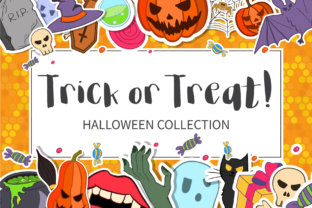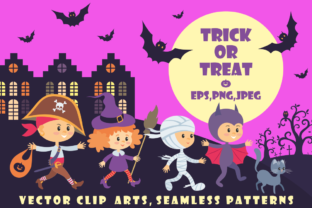
Trick or Treat 18 Children in Halloween Costumes: A Versatile Vector Resource for Creative Professionals
For designers, educators, small business owners, and craft-based entrepreneurs, high-quality, editable Halloween-themed assets are more than seasonal decoration—they’re functional tools that support communication, branding, and product development. The Trick or Treat 18 Children in Halloween Costumes collection stands out not just for its thematic charm but for its technical versatility and production-ready structure. Unlike generic clip art packs, this resource is engineered for real-world implementation across print, digital, and merchandise workflows—making it especially valuable for users who need reliability, scalability, and creative control.
What’s Inside the Collection—and Why Format Variety Matters
The package delivers three distinct asset categories—vector clip art, transparent PNGs, and seamless patterns—each serving complementary roles in a design pipeline. Understanding how these components interrelate helps users allocate resources efficiently and avoid common pitfalls like pixelation, color mismatch, or layout rigidity.
- 18 vector clip arts in EPS format (3 files): These are fully scalable, resolution-independent illustrations of children in diverse Halloween costumes—think witches, pirates, ghosts, superheroes, and animals—all posed dynamically with expressive gestures and clear “trick or treat” energy. Because they’re built in vector format, each element (e.g., a pumpkin bucket, cape, or candy bag) can be individually selected, recolored, resized, or repositioned without quality loss. Designers working in Adobe Illustrator, CorelDRAW, or Affinity Designer benefit most from this modularity—especially when customizing apparel graphics or adapting visuals for different age groups or cultural contexts.
- 18 PNG files with transparent background, 300 dpi: These raster counterparts provide immediate usability for platforms that don’t support EPS natively—such as Canva, Cricut Design Space, Silhouette Studio, or web-based editors. At 300 dpi, they retain crispness for physical output, including greeting cards, invitations, or classroom posters. The transparent background eliminates tedious masking work, allowing fast layering over photos, textures, or branded backgrounds—ideal for social media banners, email headers, or printable party kits.
- 6 seamless patterns (EPS + JPEG, 5000 × 5000 px, 300 dpi): These aren’t simple repeats of single characters. Instead, each pattern integrates multiple costume motifs—e.g., alternating pumpkins, bats, and costumed silhouettes—in balanced, non-repetitive rhythm. The EPS versions allow infinite scaling and color adjustment; the JPEGs offer plug-and-play use in Photoshop, Procreate, or textile design software. At 5000 × 5000 pixels, they’re large enough to tile across fabric yardage, wallpaper mockups, or large-format prints without visible seams or interpolation artifacts.
Real-World Applications Across User Groups
While Halloween imagery often appears decorative, the Trick or Treat 18 Children in Halloween Costumes set supports purpose-driven outcomes—not just aesthetics. Its flexibility becomes apparent when mapped to specific professional needs.
Educators and Curriculum Developers
In elementary classrooms, visual consistency reinforces learning. Teachers use the PNG files to build themed worksheets—labeling costume parts (e.g., “point to the broomstick”), sequencing trick-or-treat steps, or creating inclusive storyboards where students insert their own narratives. The vector files let educators modify skin tones, accessories, or gender expression to reflect their student population—turning a stock illustration into a culturally responsive teaching aid. Patterns serve as subtle backgrounds for reading passages or behavior charts, reducing visual clutter while maintaining seasonal engagement.
Small Business Owners and Print-on-Demand Sellers
Merchandise creators prioritize assets that convert reliably across products. The 300 dpi PNGs meet standard requirements for platforms like Redbubble, Teespring, and Zazzle, while the EPS files enable precise alignment on curved surfaces (e.g., mugs or tote bags) and clean separation for screen printing. One user reported using a modified witch character—resized, recolored in brand palette, and layered over a subtle bat-and-candy pattern—to create a best-selling kids’ Halloween T-shirt line. Because all 18 characters share consistent line weight and stylistic proportion, mixing and matching them in group scenes feels cohesive, not haphazard.
Digital Artists and Surface Pattern Designers
Surface designers often struggle with motif density and scale variation. This collection addresses both: the six patterns differ in repeat unit size, orientation (horizontal, diagonal, grid), and motif hierarchy (some emphasize full figures; others use silhouettes or isolated props). When combined with the individual vector characters, artists can generate custom repeats—for example, placing a central “trick or treat” phrase surrounded by four rotating costumes, then tiling that composition as a new pattern. That level of compositional control is rare in off-the-shelf Halloween packs.
Technical Considerations for Optimal Use
Even well-structured assets require informed handling. Here are key considerations drawn from practical implementation:
- Color management matters: The EPS files contain untagged CMYK and RGB swatches. Users preparing for commercial print should convert to their printer’s ICC profile before final export; those designing for web or mobile should embed sRGB. The PNGs ship in RGB—no conversion needed for digital use, but avoid converting them to CMYK unless necessary, as transparency may render unpredictably.
- Transparency isn’t always neutral: While all PNGs have alpha channels, some costumes include semi-transparent elements (e.g., ghostly wisps or sheer capes). When overlaying these onto busy backgrounds, test contrast and legibility—especially for accessibility compliance (e.g., WCAG 1.4.11 Non-text Contrast).
- Pattern scaling requires intention: The 5000 × 5000 px JPEG patterns appear enormous on screen—but that’s intentional. They’re sized to accommodate large-format outputs (e.g., 24″ × 36″ posters or fabric bolts) without upscaling. For smaller applications like phone cases (typically 2480 × 2480 px), users should resample using bicubic sharper interpolation rather than nearest neighbor to preserve edge clarity.
- Editing vectors demands layer awareness: Each EPS file groups related characters (e.g., “Group 1: Fantasy Characters,” “Group 2: Animal Costumes”). Before recoloring, ungroup once to access individual layers—hair, costume, accessories—but avoid excessive ungrouping, which can disrupt path integrity in complex outlines like lace or netting.
How This Set Fits Within Broader Design Trends
Halloween design has shifted away from purely spooky tropes toward inclusive, joyful, and narrative-rich visuals. The Trick or Treat 18 Children in Halloween Costumes collection reflects that evolution: characters vary in ethnicity, ability presentation (e.g., one child uses a decorated walker; another wears hearing aids stylized as spiderweb motifs), and costume creativity—not just genre. That authenticity resonates with audiences increasingly attuned to representation, especially in educational and community-facing materials.
Additionally, the rise of hybrid physical-digital experiences—like augmented reality trick-or-treat maps or NFC-enabled greeting cards—means static assets must now serve dual purposes. The clean vector paths and transparent PNGs here integrate smoothly into AR overlays (via Unity or Spark AR), while the seamless patterns function equally well as animated tile textures in After Effects or Lottie animations.
Workflow Integration Examples
Consider two common cross-platform scenarios:
- From Classroom Poster to Digital Newsletter: An educator selects the “zombie child” PNG, places it on a purple gradient background in Canva, adds speech bubble text (“Happy Halloween!”), and exports as PNG for a printed bulletin board. Later, they open the matching EPS file in Illustrator, change the zombie’s green tone to match school colors, expand the artboard, and export as SVG for embedding in a responsive HTML newsletter—ensuring sharp rendering on all devices.
- From T-Shirt Mockup to Fabric Sample: A boutique owner imports the “superhero child” EPS into Adobe Photoshop via Place Embedded, scales it to fit a chest logo area, applies a duotone effect, and saves as layered PSD. Simultaneously, they open one of the seamless patterns in Illustrator, adjust spacing to 120% to reduce visual density, and export as a repeat swatch for Spoonflower submission—using the same base color palette for cohesion across apparel and shop decor.
No single asset solves every problem—but the Trick or Treat 18 Children in Halloween Costumes collection reduces friction at each decision point. Its strength lies not in novelty alone, but in thoughtful, production-aware execution: consistent DPI standards, intelligently grouped vectors, and patterns designed for real textile and print constraints. For professionals balancing creativity with deadlines, that reliability transforms seasonal work from reactive task to strategic advantage.
Final Thought: Beyond Decoration, Toward Intentional Design
Halloween assets too often default to cliché or oversimplification. What distinguishes this set is its grounding in utility—every file type, resolution, and organizational choice serves an observable workflow need. Whether you’re illustrating a bilingual storybook, prototyping eco-friendly packaging with compostable ink limitations, or developing sensory-friendly party visuals for neurodiverse learners, the collection adapts without compromise. It doesn’t ask users to conform to its structure; instead, it provides scaffolding flexible enough to support rigor, empathy, and originality—year after year.