Christmas Fun Bundle: A Strategic Creative Resource for Purpose-Driven Projects
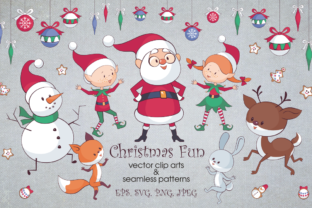
The Christmas Fun Bundle is more than a seasonal collection of clip art—it’s a purpose-built creative asset designed to support intentional, scalable, and brand-aligned work. With 28 hand-crafted colored vector clip arts and 12 seamless patterns—plus bonus line-art variants—it delivers flexibility without sacrificing quality or cohesion. For professionals who rely on visual consistency, time efficiency, and design integrity, this bundle functions as a tactical tool—not just decoration.
Why This Bundle Fits Real Workflows (Not Just Holiday Hype)
Many creators acquire holiday assets reactively—near deadlines, under pressure, or without evaluating long-term utility. The Christmas Fun Bundle stands apart because its composition reflects deliberate planning: balanced categories (4 tree bulbs, 3 ornaments, 4 themed cookies, 6 stockings, 3 gifts), thoughtful groupings (Santa + deer, elves + cookies, tree + animals), and consistent stylistic execution. That coherence matters when you’re building a cohesive product line, launching a branded campaign, or maintaining visual continuity across physical and digital touchpoints.
For small business owners producing greeting cards or mugs, the transparent-background PNGs eliminate hours of manual masking. For educators designing classroom materials, the clean SVG and EPS files scale flawlessly on handouts or interactive whiteboards. For marketers running December email campaigns, the seamless patterns allow rapid background creation—no tile alignment headaches, no licensing ambiguity.
Strategic Use Cases Across Roles
How you apply the Christmas Fun Bundle depends less on what it contains—and more on your goals, timeline, and audience expectations.
- Entrepreneurs & Small Business Owners: Launch limited-edition merchandise with minimal design overhead. Pair the snowman pattern with the “Boy elf” clip art to create a cohesive mug series—then reuse the same elements across Instagram posts and packaging. Consistency builds recognition; reusability protects margins.
- Freelancers & Designers: Offer faster turnarounds without compromising originality. Use the layered EPS files to recolor elements per client brand guidelines—or combine the “Deer pattern” with custom typography for a boutique client’s holiday newsletter. The line-art bonus files also serve as starting points for hand-drawn reinterpretations.
- Educators & Content Creators: Build reusable lesson assets. The “Girl elf” and “Bunny” clip arts integrate cleanly into printable worksheets or digital flashcards. Because all PNGs are 300dpi with transparent backgrounds, they retain clarity whether printed at A4 size or embedded in a Canva presentation.
- Bloggers & Publishers: Elevate seasonal content without stock-image fatigue. Instead of generic pinecones or overused Santa silhouettes, use the “Santa Claus, elves and animals pattern” as a subtle blog header texture—or isolate the “Fox” clip art to illustrate a story about forest-themed winter traditions.
What to Consider Before You Integrate It
Even high-quality assets require strategic framing. Without clear intent, the Christmas Fun Bundle can become clutter—not leverage. Ask yourself:
- Does this align with my brand voice? Whimsical clip art may suit a children’s boutique but undermine authority for a financial advisory firm’s holiday message. Review the bundle’s tone: friendly, warm, slightly playful—but not cartoonish or infantilized. That nuance makes it adaptable, not universal.
- What’s my output format? If you’re exporting to web-only formats, SVGs offer crisp scalability and smaller file sizes. For print production (e.g., t-shirts, greeting cards), lean on the 5000×5000px JPEG patterns and 300dpi PNGs—ensuring sharp detail at real-world sizes.
- Do I need exclusivity—or interoperability? These are royalty-free assets, but they’re not exclusive. Avoid using isolated elements (like the “Snowman” or “Santa Claus”) as sole identifiers in logos or trademarks. Instead, combine them with custom typography, layout, or color systems to build distinctive, ownable expressions.
Avoiding Common Implementation Pitfalls
Three missteps reduce the Christmas Fun Bundle’s strategic value:
- Overloading compositions. Its strength lies in simplicity—not density. A greeting card featuring six different clip arts competes for attention. Choose one focal element (e.g., the “Christmas tree and animals pattern”) and pair it with ample whitespace and strong typography.
- Ignoring color context. While the colored files are vibrant and cohesive, they assume a warm, traditional palette. If your brand uses cool-toned blues or monochrome schemes, use the bonus line-art files as base layers—then fill with your exact brand colors in Illustrator or Affinity Designer.
- Treating patterns as static backgrounds. Seamless patterns shine when scaled intentionally. Try reducing opacity for subtle texture behind text, or layering the “Elves and Santa pattern” beneath a semi-transparent gradient to create depth in a social media banner.
Long-Term Value Beyond the Holiday Season
Seasonal assets often gather dust after January. But the Christmas Fun Bundle supports longer-term thinking. Its animal motifs (deer, fox, bunny) and character-driven designs (elves, snowman) extend naturally into winter themes—even early spring if paired with neutral palettes or minimalist layouts. The “Cute animals pattern,” for instance, works year-round in educational contexts or wellness branding emphasizing gentleness and renewal.
Moreover, the technical versatility—EPS for legacy workflows, SVG for modern web, high-res PNGs for print—means these files remain usable across software updates and platform shifts. Unlike raster-only bundles that pixelate when scaled, vector-first assets preserve fidelity whether deployed in Figma, Adobe Creative Cloud, or open-source tools like Inkscape.
Practical Planning Tips for Maximum Return
To extract sustained value from the Christmas Fun Bundle, treat it like infrastructure—not decoration:
- Map assets to your annual calendar. Identify three key moments: pre-holiday product launches (October–November), core holiday engagement (December 1–24), and post-holiday reflection or early-bird planning (January). Assign specific clip arts or patterns to each phase—e.g., use “Christmas gifts” for promo graphics, “Stockings” for loyalty program visuals, and “Elves and cookies” for behind-the-scenes team appreciation posts.
- Create a style guide snippet. Document how you’ll adapt colors, spacing, and combinations. Example: “All t-shirt designs use only the star-shaped cookie + ‘Snowman’ clip art, set against solid navy or cream. Never stack more than two elements vertically.” Constraints fuel consistency.
- Batch-create variations upfront. Spend one focused session recoloring five key clip arts into your brand palette. Save those as new SVG/PNG files. Later, you’ll pull ready-to-use versions instead of adjusting hues mid-deadline.
Final Thought: Tools Serve Strategy—Not the Reverse
The Christmas Fun Bundle doesn’t guarantee better results. It enables them—if aligned with clear objectives, realistic timelines, and audience-centered decisions. Its value multiplies when treated as part of a larger system: integrated with your brand standards, responsive to your production constraints, and evaluated against measurable outcomes (e.g., faster design cycles, higher customer engagement on holiday emails, cleaner merch mockups).
When you choose assets deliberately—not just conveniently—you invest in clarity, efficiency, and creative confidence. That’s how a collection of 28 clip arts becomes a quietly powerful part of your professional toolkit.