Why the Folk Art Collection Is Reshaping Creative Workflows for Designers and Brands
In an era where authenticity, cultural resonance, and visual cohesion drive consumer trust and engagement, designers, marketers, and product creators are increasingly turning to purpose-built, culturally grounded asset libraries. Among these, The Folk Art Collection has emerged not as just another graphic pack—but as a strategic creative resource rooted in Scandinavian folk traditions and engineered for real-world versatility.
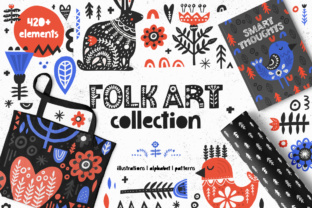
This isn’t nostalgia repackaged. It’s heritage translated into scalable, production-ready design infrastructure—over 420 meticulously crafted elements spanning animals, botanicals, symbols, typography, and patterns—all unified by the clarity, restraint, and warmth characteristic of Finnish, Norwegian, and Swedish folk art.
A Collection Designed for Integration, Not Isolation
At its core, The Folk Art Collection is a cohesive system—not a grab bag of illustrations. Its 307 full-color folk illustrations, 79 minimalist black-and-white symbols, 26 hand-styled English alphabet letters (in EPS and PNG across three color variations), six repeatable patterns, and six pre-made greeting card templates were conceived to interoperate. A fox illustration doesn’t sit apart from the “F” glyph—it invites pairing. A sprig of lingonberry leaves aligns seamlessly with a heart motif or a geometric border, enabling consistent visual language across touchpoints: from Shopify product mockups to Instagram story templates, from limited-run apparel to branded stationery.
This interoperability reflects a broader shift in creative workflows. Professionals no longer treat assets as isolated components—they expect them to behave like modular systems. Designers building brand toolkits for small businesses, freelancers producing seasonal collections for print-on-demand platforms, or marketing teams launching eco-conscious lifestyle brands all benefit from assets that share proportion, stroke weight, stylistic rhythm, and cultural logic. The Folk Art Collection delivers precisely that: a harmonized visual vocabulary, not just decorative flair.
Meeting the Demand for Meaningful Authenticity
Consumers today don’t just respond to aesthetics—they respond to intention. The rise of “slow design,” conscious consumption, and regional storytelling has elevated expectations around cultural integrity. Generic vector packs—designed without geographic or historical grounding—no longer suffice for brands positioning themselves as thoughtful, sustainable, or community-oriented.
The Folk Art Collection meets this demand head-on. Its motifs draw direct inspiration from traditional Finnish käsityö (handicraft), Norwegian rosemaling-adjacent flourishes, and Swedish dalakultur symbolism—not as pastiche, but as respectful distillation. The 54 flowers reflect native Nordic species like cloudberry and wood anemone; the 24 trees include birch, pine, and rowan—species deeply embedded in folklore and seasonal ritual. Even the 120 small details—circles, triangles, dots—are arranged with the rhythmic repetition found in historic textile borders and painted woodenware.
This level of contextual fidelity matters. When a wellness brand uses the collection’s soft-edged hearts and leaf clusters on packaging, it signals care—not just curation. When an indie publisher sets a children’s book title in the included folk-style alphabet, it evokes intergenerational continuity. That resonance isn’t accidental. It’s built into the collection’s DNA.
Practical Flexibility Across Channels and Constraints
What makes The Folk Art Collection especially valuable for professionals is its technical readiness for diverse production pipelines:
- Scalable vector formats (EPS) ensure crisp reproduction—from tiny embroidery files to large-format wall posters.
- Multiple PNG variants (including transparent backgrounds and three curated color palettes) streamline integration into digital mockups, social ads, and web design tools without color correction overhead.
- Black-and-white symbols serve dual purposes: they’re ideal for laser engraving, screen printing, and monochrome branding—while also offering flexibility for custom coloring in design software.
- Six bonus patterns (provided in EPS, JPG, and PNG) eliminate the need to tile or recolor assets manually—critical for rapid prototyping of fabric swatches, website backgrounds, or packaging repeats.
- Six pre-made cards (EPS and JPG) provide immediate starting points for greeting card lines, subscription box inserts, or retail thank-you notes—cutting time-to-market by days, not weeks.
This isn’t about convenience alone. It’s about reducing friction between concept and execution—so creatives spend less time adapting assets and more time solving brand challenges.
Aligning With Broader Industry Shifts
The relevance of The Folk Art Collection extends beyond its contents. It mirrors several converging trends shaping creative industries:
- Localization at Scale: Global brands increasingly localize visual identity for Nordic and Northern European markets—not through translation alone, but through culturally resonant iconography. This collection offers ready-to-deploy motifs that feel native, not imported.
- Hybrid Craft-Digital Practice: As tools like Procreate, Adobe Express, and Canva lower barriers to creation, demand grows for high-fidelity, stylistically coherent assets that bridge analog sensibility and digital precision. These illustrations deliver both texture and scalability.
- Sustainability-Driven Design Systems: Eco-conscious brands favor reusable, long-lived visual assets over disposable trends. Folk motifs—rooted in nature, seasonality, and craft—naturally support sustainability narratives without performative styling.
- Small-Business Empowerment: Entrepreneurs launching Etsy shops, local cafes, or handmade goods lines need professional-grade visuals without hiring illustrators. This collection provides studio-level consistency at accessible cost and effort.
Real-World Application: Beyond the Preview Grid
Consider how a freelance surface pattern designer used the 301 leaves and 54 flowers to develop a textile line for a Scandinavian home goods startup—mixing motifs across scale and orientation while maintaining rhythmic harmony. Or how a university communications team adapted the black-and-white symbols into a campus-wide wayfinding system, using simplified leaf and star icons for sustainability initiatives and academic milestones. Or how a children’s author paired the rabbit, fox, and bird illustrations with the folk alphabet to create an illustrated phonics guide—where each letter appears alongside a native animal, reinforcing literacy and ecological literacy simultaneously.
These aren’t edge cases. They reflect how professionals leverage The Folk Art Collection as infrastructure—not decoration.
Looking Ahead: Heritage as a Living Framework
Folk art has never been static. Traditionally, it evolved with materials, tools, and community needs—adapting motifs across generations while preserving core values: connection to land, reverence for craft, and celebration of shared stories. The Folk Art Collection honors that legacy not by freezing it in time, but by making it functional for today’s creative economy.
For professionals who balance artistic integrity with delivery deadlines, cultural nuance with commercial viability, and tradition with innovation—the collection offers something rare: a foundation that supports both vision and velocity. It doesn’t ask users to choose between authenticity and efficiency. It enables both.
As design continues its pivot toward meaning, modularity, and mindful production, resources like The Folk Art Collection will become less of a “nice-to-have” and more of a baseline expectation—especially for those building brands, products, and experiences rooted in place, people, and enduring values.