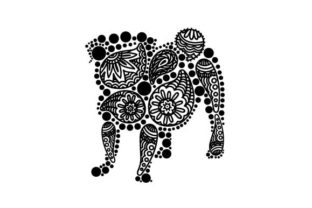
Dog Made of Paisley Patterns: A Versatile Design Asset for Creative and Professional Workflows
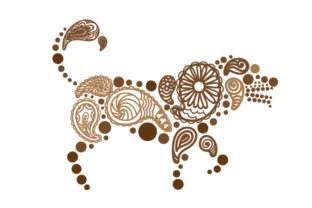
A Dog Made of Paisley Patterns is more than a decorative motif—it’s a precisely crafted, scalable vector asset designed for seamless integration across digital and print environments. This design features a stylized canine form composed entirely of intricate, repeating paisley motifs: swirling teardrop shapes, curved botanical flourishes, and rhythmic negative space that maintains visual balance while reinforcing thematic cohesion. It’s delivered in four production-ready formats—SVG, transparent PNG, EPS, and DXF—each serving distinct roles in planning, execution, and delivery phases of creative or business projects.
Where This Design Fits in Real-World Workflows
The value of the Dog Made of Paisley Patterns emerges not from its aesthetic alone, but from how it functions within existing processes. For designers building brand identities for pet wellness startups, it serves as a signature icon that communicates both playfulness and sophistication. For educators developing inclusive lesson materials on pattern recognition or textile history, it becomes a tactile, culturally grounded teaching tool. Freelance marketers use it to visually anchor social media campaigns around themes like heritage, rhythm, or mindful repetition—concepts that resonate with audiences seeking authenticity over algorithmic polish.
Unlike generic clipart, this asset is built for precision. Its SVG version scales infinitely without pixelation—ideal for responsive websites or high-DPI displays. The transparent PNG ensures clean layering over photos or gradients in presentations or email headers. EPS supports legacy print workflows, especially when collaborating with commercial printers who require PostScript compatibility. And the DXF file bridges digital design with physical fabrication—enabling laser-cut signage, engraved dog tags, or CNC-milled wall art for boutique pet spaces.
Integration Before, During, and After Core Tasks
Before a project begins, the Dog Made of Paisley Patterns helps align stakeholders through visual prototyping. A small business owner drafting a rebrand brief can embed the SVG into a mood board alongside typography samples and color palettes—giving designers immediate context about tone, scale, and stylistic intent. No need to describe “a playful yet refined dog motif”—the asset does that work. Similarly, educators preparing a unit on cultural motifs can preview how the design interacts with historical paisley references from Kashmir, Persia, or 1960s Western counterculture—making abstract concepts concrete before lesson planning starts.
During execution, the format choice directly impacts efficiency. If you’re building a Shopify store for handmade dog accessories, inserting the SVG into your theme’s header code preserves sharpness across devices—and avoids loading multiple image sizes. If you’re designing packaging in Adobe Illustrator, placing the EPS version into your layout maintains vector fidelity during color separation and spot-color proofs. And if you’re fabricating custom merch for a local dog-walking co-op, importing the DXF into LightBurn or AutoCAD lets you adjust kerf compensation, nesting density, and cut order—reducing material waste and machine runtime.
After delivery, consistency matters. Because all four formats originate from the same vector source, updating one element—like changing the base color in the SVG—can inform revisions across other outputs. That means marketing teams don’t risk mismatched branding between a website banner (SVG), trade show backdrop (EPS), and promotional keychains (DXF). It also simplifies version control: rename files clearly (e.g., dog-paisley-v2-inkblue.svg) and store them in a shared asset library with documented usage guidelines—not just for designers, but for copywriters referencing the motif in product descriptions or customer support reps explaining design origins to curious buyers.
Practical Implementation Tips for Diverse Users
For creators and freelancers: Use the transparent PNG as a watermark on portfolio thumbnails—its complexity discourages casual copying, while its transparency keeps focus on your work. When pitching to clients, embed the SVG in Figma or Adobe XD prototypes so they see how the motif responds to hover states or dark mode toggles—not just static placement.
For entrepreneurs and small business owners: Test scalability early. Drop the SVG into your email service provider’s template builder and preview on mobile. Does the detail hold at 48px height? If not, simplify downstream by using the PNG at a fixed size optimized for inbox rendering. Also consider licensing: this asset is intended for commercial use, but verify whether derivative works (e.g., recoloring + adding text) fall under standard terms—or require attribution in specific contexts like open educational resources.
For educators and publishers: Leverage the DXF for hands-on learning. Import it into free CAD tools like LibreCAD or Tinkercad, then guide students through modifying spacing between paisley units to explore rhythm, symmetry, and tessellation. Pair that activity with a short reading on how paisley evolved from Mughal floral motifs to global textile shorthand—connecting visual analysis to cultural literacy.
Compatibility, Usability, and Long-Term Value
This design was built with interoperability in mind—not as a novelty, but as infrastructure. All formats preserve clean paths and minimal anchor points, reducing file bloat and ensuring smooth import into platforms like Canva, Cricut Design Space, Silhouette Studio, and Figma. No hidden raster layers, no embedded fonts, no proprietary effects. That means less troubleshooting during handoff and fewer surprises when exporting for third-party vendors.
Usability extends beyond technical specs. The composition balances recognizability (you see “dog” first) with decorative richness (paisley as texture, not distraction). That duality makes it adaptable: zoomed out, it reads as an icon; zoomed in, it rewards attention with layered detail. For long-term use, treat it like any core brand asset—document its role in your style guide, archive source files separately from edited versions, and revisit usage annually. Does it still reflect your audience’s evolving expectations? Has its application expanded beyond initial assumptions? (One illustrator, for example, began using the DXF to generate generative art prints by feeding its path data into Processing—proving utility far beyond its original scope.)
Workflow Observations Worth Noting
You’ll notice faster iteration when you match format to function—not habit. Defaulting to PNG for everything adds unnecessary weight to web builds; defaulting to SVG for laser cutting introduces scaling errors unless units are explicitly set. Spend five minutes reviewing each format’s strengths before starting a task.
You’ll also find quality control improves when you test across real conditions—not just software previews. Print a 2-inch EPS sample on uncoated stock. Run the DXF through a 10% power test cut on scrap acrylic. Preview the SVG in Safari, Chrome, and Firefox. Small variances surface quickly, and addressing them early prevents delays later.
Finally, remember that consistency doesn’t mean rigidity. The Dog Made of Paisley Patterns works because it’s both distinctive and flexible—able to anchor a cohesive system while adapting to new contexts. Whether it’s animating subtly on a landing page, etching cleanly onto reclaimed wood, or illustrating a chapter opener in a self-published guide to mindful pet care, its role is defined by your process—not the other way around.