Heart Made of Paisley Patterns: A Versatile Design for Meaningful Expression
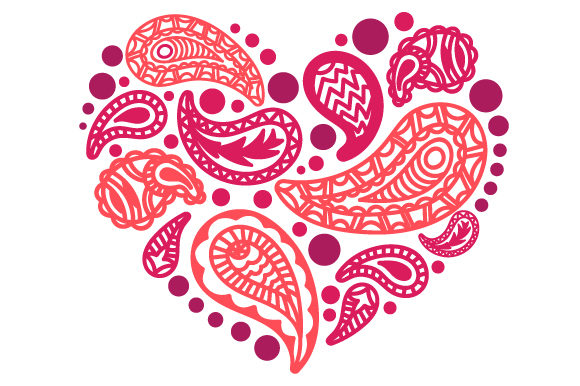
A Heart Made of Paisley Patterns isn’t just a decorative motif—it’s a visual bridge between emotion and artistry. At its core, it’s a heart shape composed entirely of intricate, swirling paisley motifs: teardrop-shaped forms layered with fine scrolls, floral flourishes, and rhythmic repetition. Unlike a solid heart or a simple outline, this design carries cultural resonance (paisley has roots in Persian and Indian textile traditions) and tactile richness—even in digital form. Because it’s delivered in multiple professional-grade formats—SVG, transparent PNG, EPS, and DXF—it’s built to move seamlessly from screen to surface, concept to creation.
Where This Design Fits Naturally in Real Life
This isn’t a “just-in-case” graphic. It finds purpose where warmth, identity, and craftsmanship intersect. Consider these everyday scenarios:
- Small business branding: A local apothecary uses the Heart Made of Paisley Patterns as a subtle watermark on product labels and thank-you cards—softening the clinical feel of wellness packaging while reinforcing care and heritage.
- Wedding stationery: A couple incorporates the SVG version into their digital invitation suite—scaling it perfectly for a monogram on the RSVP card, then converting the same file to cut-ready DXF for laser-etched wooden place cards.
- Apparel and accessories: An indie fashion designer layers the transparent PNG over fabric swatches in design software, testing how the pattern interacts with linen, silk, and denim before committing to print runs.
- Home decor projects: Someone updating their living room stencils the EPS version onto a gallery wall using a Cricut machine—then traces the same vector path by hand for a custom mural with soft watercolor washes.
Who Benefits—and How Their Needs Differ
The beauty of this design lies in how flexibly it serves distinct goals across audiences:
Crafters and makers lean on the DXF and SVG files for precision cutting—whether it’s vinyl decals for mugs, wood inlays for jewelry boxes, or embroidery templates. The clean vector paths mean no pixelation, even when enlarged to 24 inches wide. One quilter we spoke with used the SVG to generate a paper piecing pattern, adjusting spacing between paisley elements to match her fabric scale.
Graphic designers and marketers appreciate the transparent PNG for quick mockups—dropping it into social media banners, email headers, or presentation slides without background cleanup. Because the pattern is built into the shape (not overlaid), it maintains integrity at small sizes—like a favicon or app icon—without losing legibility.
Print-on-demand creators rely on the EPS format for compatibility with legacy RIP (raster image processing) systems used by commercial printers. That means fewer surprises when going from screen to large-format poster or fabric roll printing—especially important when color fidelity matters (e.g., matching brand Pantones across merch lines).
Practical Things to Keep in Mind Before You Use It
While versatile, thoughtful application makes all the difference. Here’s what experienced users watch for:
- Scale and context: Paisley’s detail thrives at medium-to-large sizes. Below 1 inch wide (in print), fine scrollwork may blur or vanish—especially in low-resolution outputs. If you need a tiny version, test the transparent PNG at actual output size first.
- Color contrast: The interwoven nature of the pattern means light-on-dark or dark-on-light works best. Avoid mid-tone backgrounds (like heather gray or beige) unless you add a subtle drop shadow or stroke—otherwise, the heart’s edges can visually recede.
- File format alignment: Don’t default to PNG for everything. Need crisp resizing? Use SVG or EPS. Prepping for CNC routing? DXF is your go-to. Sending to a print shop that requests “vector only”? Skip the PNG entirely—it’s raster-only and won’t scale cleanly for large banners or signage.
- Cultural sensitivity: Paisley carries centuries of meaning—from Kashmiri shawls to 1960s counterculture. When using the Heart Made of Paisley Patterns for branding or storytelling, consider whether that resonance aligns with your message. A yoga studio might highlight its origins in mindfulness; a tech startup might focus on its rhythmic, interconnected geometry instead.
Strengths That Make It Stand Out
What sets this design apart from generic hearts or stock paisley fills?
First, it’s intentionally unified: the heart isn’t decorated *with* paisley—it’s *built from* it. That structural harmony gives it visual weight and narrative cohesion. Second, the multi-format delivery removes friction—you’re not hunting for conversions or risking quality loss. Third, the transparency in the PNG and vector scalability mean it adapts to both analog and digital workflows without compromise.
We’ve seen educators use the SVG to illustrate symmetry and tessellation in middle-school math lessons. Wedding planners embed the DXF into acrylic cake toppers that double as guest favors. Even therapists have printed the transparent PNG on laminated cards for grounding exercises—inviting clients to trace the flowing lines slowly with their fingers.
When to Pause and Reconsider
This design shines when authenticity, texture, and emotional tone matter—but it’s not always the right fit. For example:
- If your project demands ultra-minimalist aesthetics (think Scandinavian office branding), the ornamental density of paisley may compete with clean lines and negative space.
- In fast-paced digital ads where split-second recognition is key, a simpler heart icon may outperform this version—clarity often beats complexity in micro-moments.
- If you’re working with strict brand guidelines that forbid patterned icons or require rigid geometric proportions, the organic flow of paisley could require adaptation—or a different approach altogether.
None of these are flaws—they’re cues. They tell you when the Heart Made of Paisley Patterns is the perfect vessel for meaning, and when another symbol might serve your audience better.
Bringing It Into Your World—Without Overcomplicating It
You don’t need specialized software to begin. Most free tools—like Canva (for PNG/SVG), Inkscape (for EPS/DXF), or even Apple Pages—handle these formats well. Start small: try the transparent PNG as a watermark on a personal blog header, or paste the SVG into a note-taking app to sketch layout ideas. Notice how the curves guide the eye, how the repetition feels calming, how the heart shape grounds the intricacy.
What makes this design enduring isn’t just its visual appeal—it’s how easily it becomes part of your process. Whether you’re laser-cutting coasters, designing a memorial garden plaque, or illustrating a children’s book about kindness, the Heart Made of Paisley Patterns offers both structure and soul. It’s ready—not as a final answer, but as a thoughtful, adaptable starting point.