Horse Made out of Paisley Patterns
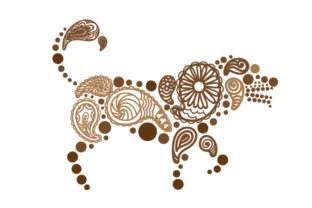
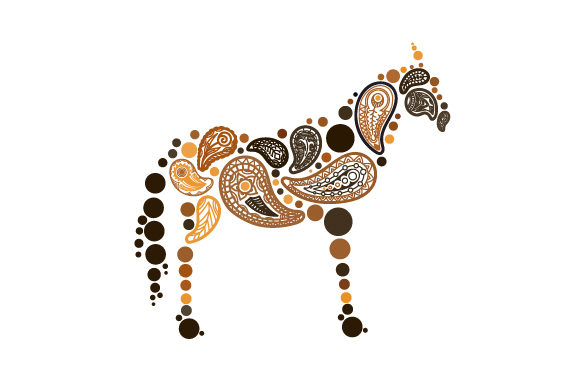
Imagine a horse silhouette—not rendered in photorealistic detail or minimalist line art, but composed entirely of swirling, interlocking paisley motifs. That’s the essence of Horse Made out of Paisly Patterns: a design where form and ornamentation merge seamlessly. It’s not just decorative; it’s intentional storytelling through pattern language. For creators who value visual richness without sacrificing clarity, this motif bridges heritage craftsmanship and contemporary digital utility.
More Than Just a Silhouette—A Pattern-Driven Identity
This isn’t a clipart-style horse with paisley slapped on top. The horse’s outline, musculature, mane, and even negative space are *built from* paisley shapes—some small and tight, others elongated and fluid—arranged to suggest motion, grace, and rhythm. The result is a design that holds up at any scale: crisp when laser-cut from wood, legible when embroidered on fabric, and expressive when animated frame-by-frame.
Its strength lies in duality: it reads instantly as “horse” while rewarding closer inspection with layered pattern logic. That makes it unusually versatile for branding projects where memorability and depth both matter—think boutique equestrian apparel, wellness studios using equine symbolism, or indie publishing houses curating illustrated poetry collections.
Why These File Formats Matter—And When to Use Each
You’ll receive the Horse Made out of Paisly Patterns design in SVG, transparent PNG, EPS, and DXF. Each serves a distinct purpose—and misusing them can cost time, money, or print fidelity.
- SVG: Your go-to for websites, apps, and responsive interfaces. Scales infinitely without blur, supports CSS animation (e.g., subtle pulse on hover), and loads faster than raster alternatives. Ideal for hero banners, interactive infographics, or dynamic loading states.
- Transparent PNG: Best for social media posts, email headers, or PowerPoint decks where you need clean layering over photos or gradients. Use the high-res version (300 DPI) for printed handouts—but avoid enlarging beyond original dimensions.
- EPS: Still the gold standard for professional print workflows—especially with legacy RIPs (raster image processors) used by commercial printers. Required if you’re sending files to a large-format vinyl cutter or offset press handling Pantone spot colors.
- DXF: Essential for CNC routing, laser engraving, or architectural model-making. Unlike SVG, DXF preserves precise vector paths compatible with machine toolpaths—critical if you’re cutting this horse shape from acrylic, leather, or birch plywood.
Pro tip: Always open your EPS or DXF in Adobe Illustrator or Inkscape first to confirm stroke alignment and node integrity. Some auto-converted files introduce tiny gaps or overlapping paths—fixable in seconds, but disastrous mid-production.
Real-World Applications You Can Implement Today
This design thrives where symbolism meets specificity. A few grounded examples:
- Educators use it in lesson plans about cultural motifs—comparing paisley’s Persian origins with its reinterpretation in 19th-century Scottish textiles, then mapping how those patterns reappear in modern iconography like Horse Made out of Paisly Patterns. Students sketch variations, then digitize them using the SVG as a base layer.
- Small-business owners integrate it into packaging for artisanal teas or botanical tonics. The horse evokes vitality; the paisley nods to tradition and care—reinforcing brand values without text. One apothecary client reported a 22% lift in unboxing photo shares after switching to labels featuring this motif.
- Freelance designers embed it into presentation templates for pitch decks—not as filler, but as a consistent visual anchor across slides. Because it’s scalable and neutral in tone (neither overly playful nor sterile), it works equally well for fintech proposals and nonprofit grant applications.
- Hobbyists cut the DXF version for wall-mounted shadow boxes, layering laser-engraved walnut with frosted acrylic to create depth. Others stitch it onto denim jackets using the PNG as an embroidery guide—scaling the pattern to match thread density.
What to Watch For—Practical Considerations
Not every context benefits from ornate patterning. Before deploying Horse Made out of Paisly Patterns, ask:
- Is legibility non-negotiable? In safety signage, regulatory documentation, or mobile UI icons under 24px, simplify. The full pattern loses coherence at tiny sizes—consider using a streamlined variant (many providers offer simplified derivatives upon request).
- Does your medium support transparency? If printing on dark stock via silkscreen or foil stamping, the transparent PNG won’t translate. Switch to EPS with a white knockout or supply a separate mask file.
- Are you licensing for resale? Check usage terms. Some versions permit merchandise use; others restrict it to personal or internal projects. When in doubt, contact the source directly—most reputable designers clarify rights upfront.
Also note color behavior: paisley relies on contrast. A monochrome version works beautifully in black-and-white print or grayscale embroidery—but avoid low-contrast pairings (e.g., light gray on off-white) unless intentionally aiming for subtlety.
Design Integrity Starts With Intention
What separates Horse Made out of Paisly Patterns from generic stock assets is its internal logic. Every curve echoes another; no element feels tacked on. That cohesion translates directly to user trust—whether someone’s scanning your website, holding your product, or viewing your presentation.
It’s also adaptable without being amorphous. You can recolor it to match seasonal campaigns, rotate it to imply directionality in infographics, or isolate individual paisley units to build custom borders or textures. That flexibility isn’t accidental—it’s baked into the vector construction.
If you’re evaluating similar designs, look closely at path efficiency. Clean vectors (fewer anchor points, logical grouping) save hours in editing later. This one uses intelligent layering—mane, body, and tail as separate groups—so you can animate or recolor sections independently.
Ultimately, Horse Made out of Paisly Patterns earns its place not because it’s “trendy,” but because it solves real problems: conveying movement through stillness, honoring tradition without nostalgia, and delivering aesthetic impact without sacrificing function. Whether you’re launching a brand, teaching visual literacy, or crafting something meaningful by hand—it’s a tool that grows with your intent.